Which wasp is it?
Yellowjackets
Black and yellow, about half an inch, with a quick side-to-side flight.
In Madison they nest most often in the ground, under decks and landscape timbers, and inside wall voids, entering through a small gap in siding or at the sill.
Colonies grow to thousands of workers by late summer, and they become aggressive around food and when the nest is disturbed. They are the stinging insect behind most picnic and lawn-mowing stings.
Bald-faced hornets
Black and white, larger than yellowjackets. They build gray, football-shaped paper nests in trees, shrubs, under eaves and on the sides of sheds.
They defend the nest aggressively when disturbed, often by people trimming hedges or mowing nearby.
Paper wasps
Long-legged brown wasps with yellow markings. They build open, umbrella-shaped combs under eaves, porch ceilings, deck railings, window shutters and play sets. They are less aggressive unless the nest is bumped.
Why August and September are the worst
Wasp colonies start in spring with a single queen and grow all summer.
By late summer they are at full size and their diet shifts toward sugar, which brings them to trash cans, drinks and fallen fruit. That is when people get stung most.
The first hard freeze in fall kills the workers, and only new queens survive the winter in sheltered spots. Old nests are not reused.
Near Hilldale area, wasps turn up at the attic hatch before they turn up in the main rooms.
Identify and locate
The technician watches the flight path to find the entrance, especially for ground and wall nests that are not visible. The species decides the method.
Treat the nest
- Ground nests. A dust is applied into the entrance, which workers carry through the nest.
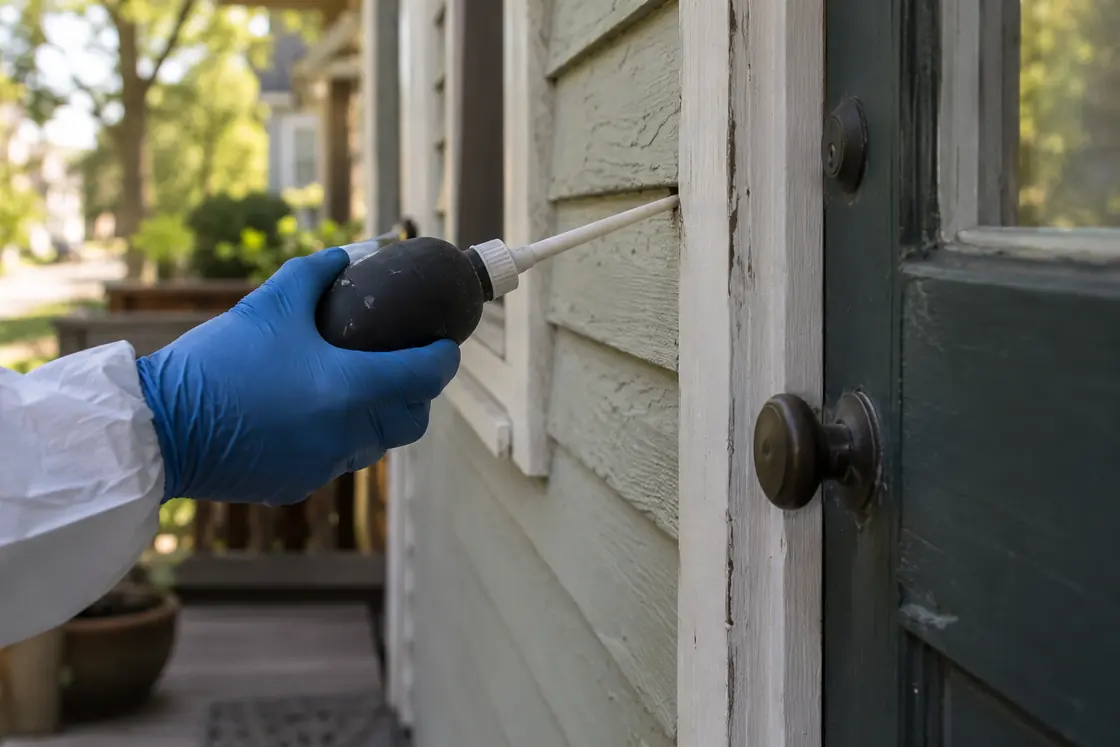
- Wall voids. The entrance hole is treated with a dust. The hole is not sealed until the colony is dead, because blocked yellowjackets can chew through drywall into the house.
- Hanging nests. Bald-faced hornet and paper wasp nests are treated, then removed once activity has stopped.
Protective gear and the right timing, often early morning or evening when the colony is inside, make the job safer.
Remove or leave
Reachable hanging nests are removed after treatment. Wall and ground nests are left in place; they will not be reused.
What you should not do
- Do not plug the entrance of a wall nest; the wasps may chew inward
- Do not pour gasoline or set fire to a ground nest
- Do not spray a large nest from a ladder; a fall is more dangerous than the stings
- Keep children and pets away from the area until the nest is treated
The time of year in Madison changes the pressure, and wasps near Monroe Street are still confirmed at the foundation crack.
We do not seal wall nests with live wasps inside or knock down active hornet nests without treating them.
We do not treat honeybee swarms with insecticide; honeybees are a different problem, and we will tell you if that is what you have.
Wasps on lakeside and wooded lots
Homes along the lakes and next to conservancy land in Middleton, Shorewood Hills and the west side tend to have more bald-faced hornets in the trees and yellowjackets in the ground, simply because there is more habitat.
If you have a lakeside deck or a boathouse, check under railings and inside storage boxes in early summer.
Allergies
Anyone with a known sting allergy should stay well away from the nest and have their epinephrine available. Swelling far from the sting, trouble breathing or dizziness after a sting is a medical emergency.
Spring prevention
Paper wasps and yellowjacket queens start new nests in May and June.
Knocking down a small starter nest early, when it is the size of a golf ball and has only the queen, is much easier than dealing with a full colony in August.
Look under eaves, deck railings and play sets in early summer, and seal gaps in siding where yellowjackets got into the walls last year.
Wasps near the isthmus
Call when a nest is close to where people walk, sit, play or mow, or when you hear buzzing inside a wall. Call now.
Stinging insect quick facts for Madison
- Eastern yellowjacket (*Vespula maculifrons*): a common ground nester in lawns, gardens and under shrubs.
- German yellowjacket (*Vespula germanica*): often nests in wall voids, attics and sheds.
- Bald-faced hornet (*Dolichovespula maculata*): black and white, builds large gray paper nests in trees and under eaves.
- European paper wasp (*Polistes dominula*): open umbrella nests under railings, grills, eaves and play sets.
- Season: queens start nests in May, colonies peak in late August and September, and most die after a hard frost.