Why bats move into Madison homes
Big brown bats and little brown bats roost in attics, wall voids, soffits and chimneys across southern Wisconsin.
Madison's lakes, marshes and parks feed them on insects all summer, and older homes on the Isthmus and in neighborhoods like Vilas, Dudgeon-Monroe, Tenney-Lapham and Maple Bluff have the loose trim, gaps at the roofline and unscreened vents bats need.
A bat can fit through a gap about the width of your thumb.
Signs of bats
- Bats flying out of the roofline, a gable vent or the chimney at dusk
- Scratching or squeaking in the attic or walls in the evening
- Droppings that crumble into shiny specks, piled below an entry point or on attic insulation
- Brown greasy stains around a gap in the siding or trim
- A bat inside the living space, often in late summer when young bats start flying
Wisconsin rules and the pup season
Several Wisconsin bat species are protected by the state, and bats cannot be killed or poisoned to get them out of a house.
Wisconsin DNR guidance also says not to exclude bats during the summer pup season, roughly June through mid-August, because young bats that cannot fly yet would be trapped inside and die.
Exclusions are planned for spring before the colony settles, or for late summer and fall after the young can fly.
If bats are found in summer, the plan starts with an inspection and the exclusion is scheduled for the first safe date.
How bat removal works
Inspection
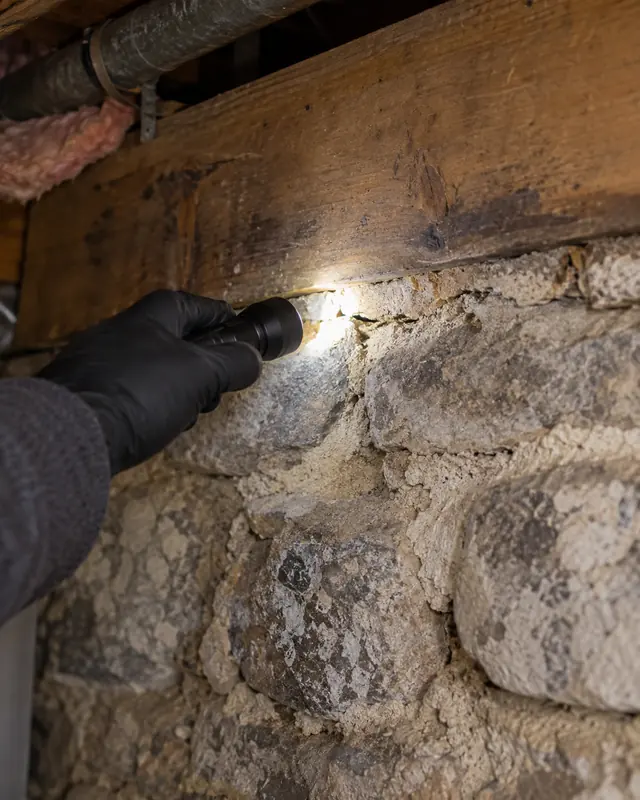
The technician watches for where the bats exit, then checks the roofline, soffits, fascia, gable vents, chimney cap, attic vents, siding gaps and the attic itself.
Every possible gap gets marked, not just the one the bats use most.
Exclusion
One-way exit devices are fitted over the active openings, so bats can leave at night to feed but cannot get back in.
The other gaps are sealed with caulk, mesh, flashing or new trim. Exits stay up for about a week, until no bats are returning.
Sealing and cleanup
Once the bats are gone, the exits come down and those openings are sealed. Droppings in the attic can be removed and the contaminated insulation replaced where the build-up is heavy.
A bat in the house
If a bat gets into the living space, close the doors to that room, open a window and turn off the lights so it can find its way out.
If you must catch it, wear thick gloves and use a container.
If a bat was found in a room where someone was sleeping, or with a child or pet, do not release it; contact your doctor or Public Health Madison and Dane County about rabies testing.
Droppings and the attic afterward
A colony that has used an attic for years can leave a thick layer of droppings on the insulation.
Guano holds moisture, smells and can grow mold, so heavy build-up is bagged out and the soiled insulation replaced, with the worker in a respirator. Light droppings along one rafter can simply be cleaned.
You get told which you have after the inspection, before any cleanup is planned.
Sealing the main hole while bats are inside traps them in the attic, where they die or find their way into the house through light fixtures, ductwork and gaps around the attic hatch.
Doing it in the right order, exits first and sealing after, avoids that.
Bats signs in Madison
Call as soon as you notice bats at the roofline or droppings in the attic, even in summer.
An early inspection means the exclusion can be ready for the first safe date. Call now and tell us where you see them coming out.
Bat quick facts for Madison
- Big brown bat (*Eptesicus fuscus*): the bat most often found in Madison attics and walls. It is the species most likely to stay in a building through the winter.
- Little brown bat (*Myotis lucifugus*): forms summer maternity colonies in attics and barns. Its numbers have dropped sharply from white-nose syndrome.
- Pup season: Wisconsin DNR guidance is to avoid excluding bats from June 1 to August 15, while pups cannot fly yet.
- Entry points: gaps of about 3/8 inch to 1/2 inch at the roofline, chimney flashing, soffits, attic vents and loose siding.
- Rabies: if a bat was in a room with a sleeping person, a child or a pet, contact a doctor or Public Health Madison and Dane County before letting it go.