Which squirrels get into Madison attics
Gray and fox squirrels
The big squirrels in Madison's yards and parks.
They chew through soffits, fascia boards, roof vents and the gaps where a gutter meets the roof, and they nest in attics, especially in late winter and summer when they raise young.
Red squirrels
Smaller, rusty-red and noisy. They are bold chewers and get into attics, walls and garages, often from trees close to the house.
Flying squirrels
Southern flying squirrels are common in wooded parts of Madison and the suburbs but rarely seen, because they come out at night.
They live in groups, glide in from nearby trees and slip through small gaps at the roofline. Night noise in the attic in fall and winter is often flying squirrels, not mice.
Signs of squirrels
- Running, rolling and scratching overhead, at dawn and dusk for gray and red squirrels, at night for flying squirrels
- Chewed holes in soffits, fascia, roof vents or siding corners
- Nesting material, nut shells and droppings in the attic
- Squirrels going in and out of the same spot on the roofline
- Chewed wiring or insulation found during attic work
Why squirrels in the attic are a problem
Squirrels chew constantly. In an attic, that means electrical wiring, insulation, duct wrap and the wood around the entry hole.
Chewed wiring is a fire risk, and nesting material, urine and droppings ruin insulation. Once one squirrel finds a way in, others follow, and the scent marks the spot for the next year.
How squirrel removal works
Inspection
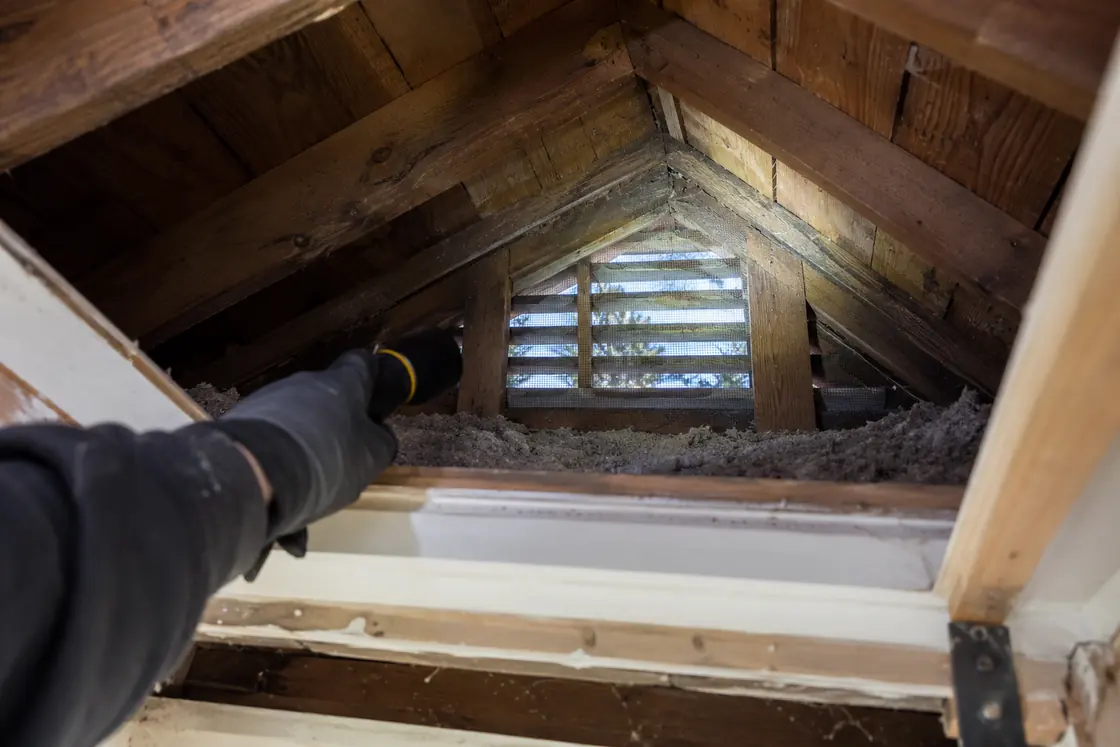
The technician walks the roofline and attic looking for chewed openings, loose vents, gaps at the gutter line and the trees and wires squirrels use to reach the roof. Every opening is noted.
One-way doors
A one-way door is fitted over the active hole, letting squirrels leave to feed but not return. The other openings are sealed first so they cannot simply use a different hole.
Sealing with metal
Once the squirrels are out, the door comes off and the opening is closed with heavy-gauge metal mesh or flashing and repaired trim.
Squirrels chew through wood, plastic vents and foam in days, so the repair has to be metal.
Babies in the attic
Gray squirrels usually have litters in late winter to early spring and again in summer. If there are young in the attic, a one-way door alone would separate them from the mother.
The technician checks for a nest and, if there is one, waits until the young are moving or removes them by hand so the family can reunite outside.
Trees, wires and bird feeders
Trimming branches back several feet from the roof, and keeping bird feeders away from the house, cuts down on how often squirrels test the roofline.
In wooded neighborhoods, a yearly look at the roofline before fall catches new chewing early.
Squirrels in walls and chimneys
Not every squirrel stays in the attic. Some drop into wall cavities and scratch behind the drywall, and some nest on the smoke shelf of an uncapped chimney.
A chimney cap with heavy mesh stops that, and a squirrel stuck in a wall is usually guided out through the same exclusion door once the other routes are closed.
What not to do
Do not seal a hole while squirrels or babies are inside; they chew a new way out, sometimes into the house.
Moving trapped squirrels across town rarely solves anything, because others move in through the same hole.
Where squirrels show up near Verona
Call when you hear squirrels overhead or see one going in and out of the roofline.
The sooner the hole is closed, the less wiring and insulation get damaged. Call now and tell us where you hear them.
Squirrel quick facts for Madison
- Eastern gray squirrel (*Sciurus carolinensis*): the most common squirrel in Madison attics. Gray and black forms are the same species.
- Fox squirrel (*Sciurus niger*): larger and reddish orange, common in open neighborhoods and parks.
- Red squirrel (*Tamiasciurus hudsonicus*): small and loud, more common near conifers and on wooded lots.
- Southern flying squirrel (*Glaucomys volans*): active at night and often mistaken for mice in the attic.
- Litters: gray and fox squirrels usually have young in late winter and again in summer, so the technician checks for babies before sealing the last hole.