What carpenter ants are
Carpenter ants are the largest ants in Wisconsin, about a quarter to half an inch long, usually black or black and reddish. They do not eat wood the way termites do.
They chew galleries into it to nest, pushing out a fine sawdust called frass that often contains bits of dead ants and insulation.
They prefer wood that is already damp or decaying.
That is why they are such a common problem in Madison's older housing stock and around the lakes, where old trees, wet springs and aging wood windows and porches give them plenty of choices.
Signs of carpenter ants
- Large black ants indoors in spring, especially in the kitchen or bathroom
- Winged ants inside in April through June, which means a mature nest nearby, possibly in the house
- Small piles of sawdust-like frass under a window, door frame, baseboard or in the attic
- Faint rustling inside a wall on a quiet night
- Ants trailing along tree branches, wires or fences that touch the house
Where nests show up in Madison homes
- Window and door frames with old caulk and a slow leak
- Porch roofs and columns, especially on older front porches
- Bathroom walls around tubs and showers
- Roof eaves and soffits with ice dam damage from past winters
- Decks and sill plates in contact with damp soil
- Firewood stacked against the house, or dead trees and stumps in the yard
A house can have a parent colony outdoors, in a tree or stump, and satellite colonies inside. Finding both matters.
Near Monona, ants turn up at the attic hatch before they turn up in the main rooms.
Inspection
Carpenter ants are most active at night, so the technician asks when and where you see them and looks for trails, frass and moisture.
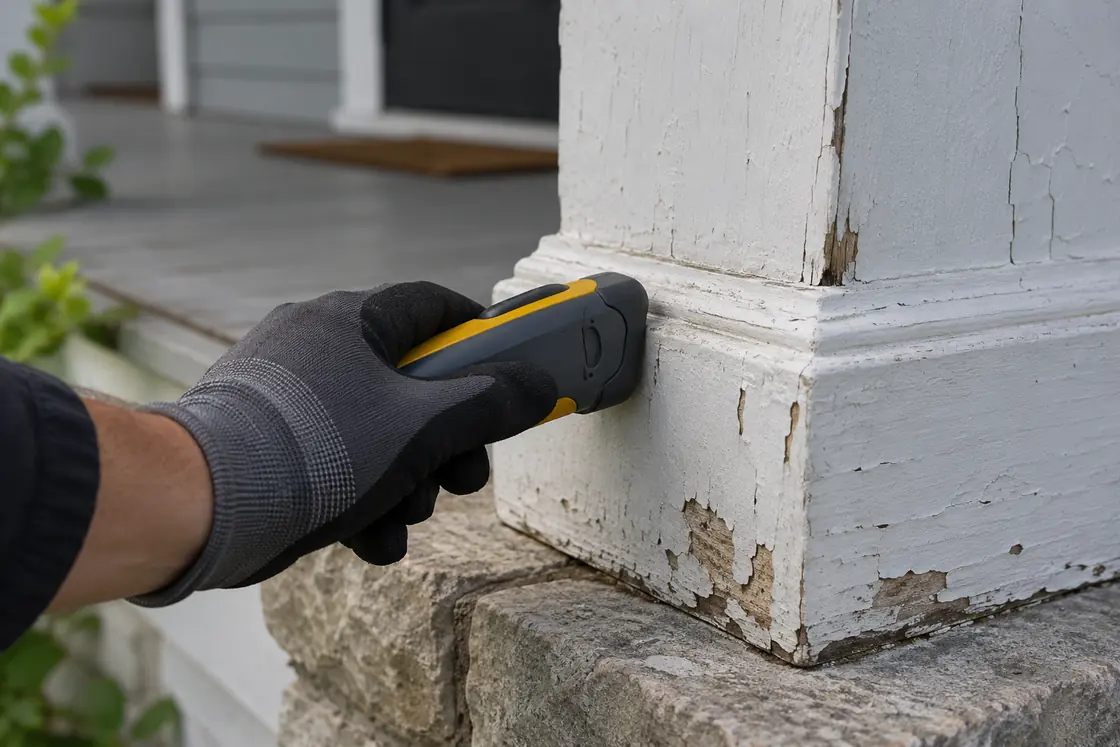
They check windows, porches, the attic, the roofline and the yard: trees, stumps, woodpiles and landscape timbers. A moisture meter and a flashlight help find the wet wood.
Direct treatment of nests
Once found, indoor nests are treated directly, often by drilling small holes into the gallery and applying a dust or foam that reaches the colony.
Baits and non-repellent treatments
Where the nest cannot be reached, baits are placed on the trails so workers carry them back.
Outside, a non-repellent treatment is applied around the foundation and at entry points such as branches, wires and the sill. Ants walking through it carry it back to the colony.
The time of year in Madison changes the pressure, and ants near Willy Street are still confirmed at the window well.
The technician points out the wet wood, leaks and contact points that drew the ants in. Fixing them is what keeps a new colony from moving in next year.
Homes around Verona get the ants inspection at the sill plate first, because that is where the activity usually starts.
- Trim tree limbs and shrubs so they do not touch the roof or siding
- Move firewood away from the house and off the ground
- Fix roof leaks, gutter overflows and window leaks
- Replace rotted wood on porches, decks and trim
- Keep mulch a few inches below the siding
What decides the ants plan in Madison is the building near Fitchburg, and the irrigation valve is on that list.
We do not spray ant trails with repellent products that scatter the colony.
We do not treat without trying to find the nest, and we do not ignore the moisture that is keeping it alive.
Carpenter ants versus termites
Termites are uncommon in Madison, but people sometimes confuse the two when they see winged insects in spring.
Carpenter ants have a pinched waist, bent antennae and front wings longer than their back wings. Termites have a thick waist, straight antennae and wings of equal length.
Carpenter ant frass is dry and loose; termite damage is packed with mud. If you are not sure, keep a few in a sealed bag for the technician.
Lakeside and wooded lots
Homes along Lake Mendota, Lake Monona and Lake Wingra, and those backing onto conservancy land in Middleton, Shorewood Hills and the west side, are surrounded by mature oaks, maples and willows, many with hollow or decaying limbs that hold large parent colonies.
On those properties, the technician spends extra time on the trees and stumps nearest the house, because an untreated parent colony outside will keep sending workers in.
What to look for near Monona
Call when you see big black ants inside in spring, winged ants indoors or piles of frass. Call now.
Carpenter ant quick facts for Madison
- Species: the black carpenter ant, *Camponotus pennsylvanicus*, the largest common ant in Wisconsin.
- Size: workers range from about 1/4 to 1/2 inch, and winged swarmers appear in late spring and early summer.
- Nest sites: window and door frames, porch roofs, decks, hollow doors, wood near leaks and dead trees or stumps in the yard.
- Sign: frass, a fine sawdust mixed with insect parts, pushed out of small openings below a nest.
- Method: find the parent nest outdoors and any satellite nests inside, treat them directly and fix the moisture that drew them in.